


When 6 TOPS Is No Longer the Limit: RK3576 + Hailo-8 Achieves True Real-Time Processing for High-Frame-Rate Cameras

2026-05-19

1784

In edge computing, the trade-off between computational power and real-time performance has always been relentless. However, recent in-depth tests using the MYD-LR3576 development board paired with a Hailo-8 AI accelerator via PCIe M.2 have produced real-world data that may challenge your perception of edge AI's "performance ceiling."

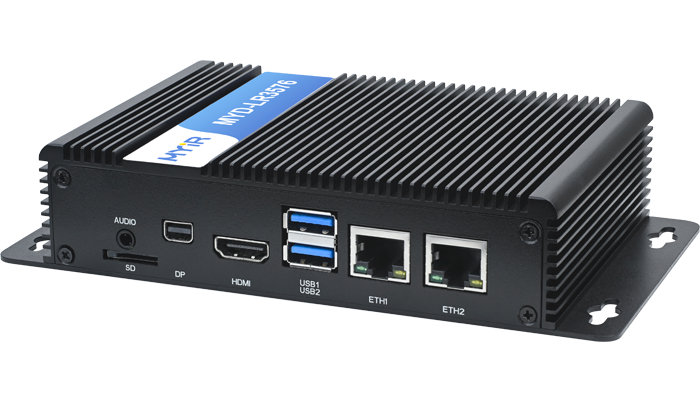
MYIR's MYD-LR3576 Development Board based on Rockchip's RK3576
1. Where Does the RK3576's Computational Power Hit Its Limit?
The built-in NPU of RK3576 consists of two cores with 6 TOPS computing power, delivering solid performance for conventional lightweight model inference. However, in our multi-stream concurrency tests, running four simultaneous YOLOv5 inference streams pushed the NPU load beyond 75%. Adding a fifth stream caused latency to spike sharply and system responsiveness to degrade significantly.
In a single-stream scenario, processing a YOLOv5 model at 640×640 resolution takes approximately 26ms, which translates to stable handling of only 30fps camera input.
What Does This Mean for Real-World Applications?
When cameras inputs scale up to high frame rates of 60fps or even 120fps, the RK3576's NPU alone can no longer sustain true frame-by-frame real-time processing. Frame loss or accumulating latency becomes inevitable. Neither is acceptable in latency-sensitive applications like industrial high-speed inspection, intelligent traffic systems, or robotic navigation, where every frame matters.
2. Hailo-8: A Purpose-Built Edge AI Accelerator
The Hailo-8 is a dedicated AI accelerator engineered specifically for edge inference. It delivers 26 TOPS of computing power while maintaining exceptional efficiency for embedded devices and low-power applications.
[Official site: https://hailo.ai/]
So how does the Hailo-8 achieve several times the performance of traditional NPU solutions at the same power budget? The answer isn't in the TOPS number but in the architecture.
1) Dataflow Architecture
Think of a traditional NPU as a factory. It constantly shuttles data back and forth to external DDR memory, and its efficiency is held back by the speed of that transfer. The Hailo-8, by contrast, uses a dataflow architecture. Data moves through the chip like an assembly line, processing as it flows and dramatically reducing trips to external memory.
Compute power isn't the bottleneck but memory bandwidth is. And Hailo-8 simply bypasses that bottleneck.
2) No External DRAM Dependency
The Hailo-8 eliminates dependency on external high-bandwidth memory. During inference, it barely contends with the CPU or NPU for DDR resources.
What does this mean for multi-stream video applications? With no memory contention to worry about, the system avoids frame loss, and overall stability improves dramatically.
3. Measured Data: Let Performance Speak for Itself
Under the same model conditions (YOLOv5s):
AI Accelerator Card | Time per frame | equivalent FPS |
RK3576 NPU | 26 ms | ~38 FPS |
Hailo-8 | 8.241 ms | ~121 FPS |
In tests with more complex models (YOLOv8s), the Hailo-8 AI Accelerator Card performed as follows in benchmark tests:

A latency of just 7 milliseconds per inference. That means the system can effortlessly keep up with even 120fps high-speed cameras, processing every single frame in real time.
To validate this, we ran Hailo-8's built-in camera real-time inference demo. Here are the results:

4. Application Scenarios: When Real-Time Performance Becomes a Critical Requirement
What practical problems can this solution address? Let's examine several typical scenarios:
Industrial High-Speed Visual Inspection
A 120fps industrial camera captures every detail on a high-speed production line. With Hailo-8’s 8ms inference latency, defects are detected and rejected in real time — preventing a single faulty part from ever reaching the next process.
Smart Traffic Checkpoints
When vehicles pass at high speed, the system must complete detection, recognition, and tracking within milliseconds. With a throughput capacity of 208 FPS, a single Hailo-8 node runs multiple models simultaneously, ensuring no vehicle is missed or license plate information is lost.
Security at the Edge
Supports simultaneous analysis of four or more 4K video streams. The high throughput of Hailo-8 doubles the coverage of each node, significantly reducing hardware costs per stream.
5. Summary: Elastic Computing Power Meets the High-FPS Challenge
Through the above tests, we can clearly see:
With the introduction of the Hailo-8 AI accelerate card, YOLOv5 inference time drops to 8ms. YOLOv8 achieves 208 FPS measured throughput. That's more than enough to handle full-frame inference for 120fps cameras with comfortable headroom to spare.
Elastic computing power, choose on demand: Cost-sensitive projects can use the RK3576 alone; for high-frame-rate and low-latency scenarios, simply add the Hailo-8 module without replacing the main controller.
Overcoming architectural limitations for true real-time performance: The Hailo-8 data stream architecture achieves over 80% effective computing power utilization, while the RK3576's PCIe 2.1 interface reduces inference latency from milliseconds to microseconds.
Reserving room for the future: In an era of rapid algorithmic iteration, the combination of RK3576 and Hailo-8 provides ample computational redundancy for algorithm upgrades over the next two years, safeguarding customers' hardware investments.


2026-08-13
MYC-LR3576: The Security Stack You Get in the SDK
OP-TEE, FIT secure boot, dm-verity, dm-crypt, CMS-signed OTA — all in the MYC-LR3576 SDK
2026-07-29
A Complete Secure Boot, Storage, and OTA Pipeline on MYIR's i.MX93 Platform
MYIR has released the V2.0.0 software version for its NXP i.MX93 based MYD-LMX9X Development Board.
2026-07-14
Building a Zero-Copy Dual-Vision System on RK3576 with DMA-BUF
Walk through the engineering path from working prototype to automotive-grade, production-ready latency using MYIR's RK3576 solution.
2025-11-27
SECC GreenPHY Solution: Bridging STM32MP135 SOM to V2G Industry Advancement
Debug MSE102x G on MYC-YF13X, providing reference for V2G communication development.
2025-11-20
SECC Solution for Charging Pile Applications
MYIR's SECC solution delivers a high-standard, low-risk rapid development platform for clients, with core strengths in protocol compatibility, operational security, and a comprehensive reference design.
2025-11-02
Simultaneous Control of 4 YOLOv8 Video Streams via MYIR's RK3576 Board
In the era of rapid technological advancement, the integration of artificial intelligence and edge computing is transforming our lives at an unprecedented pace. The RK3576 processor features a quad-co
2025-09-20
Compiling OpenCV and Developing Applications on the RK3576 Board
This article introduces how to compile OpenCV on the RK3576 development board and build an application.
2025-08-30
MYIR T536 Development Board: Multi-protocol IoT Gateway Solution Test
The article details the development and testing of a multi-protocol IoT gateway solution that utilizes MYIR's MYD-LT536 development board, which is based on the Allwinner T536 SoC.
2025-08-29
MYIR RK3576 Development Board: 12-Channel 1080p HD Video Streaming
MYIR has successfully achieved efficient H.264 encoding and low-latency RTSP streaming for 12-channel HD video streams on the Rockchip RK3576 SOM.