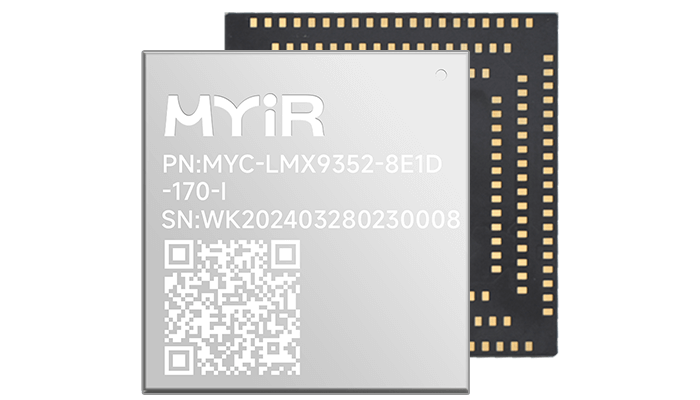
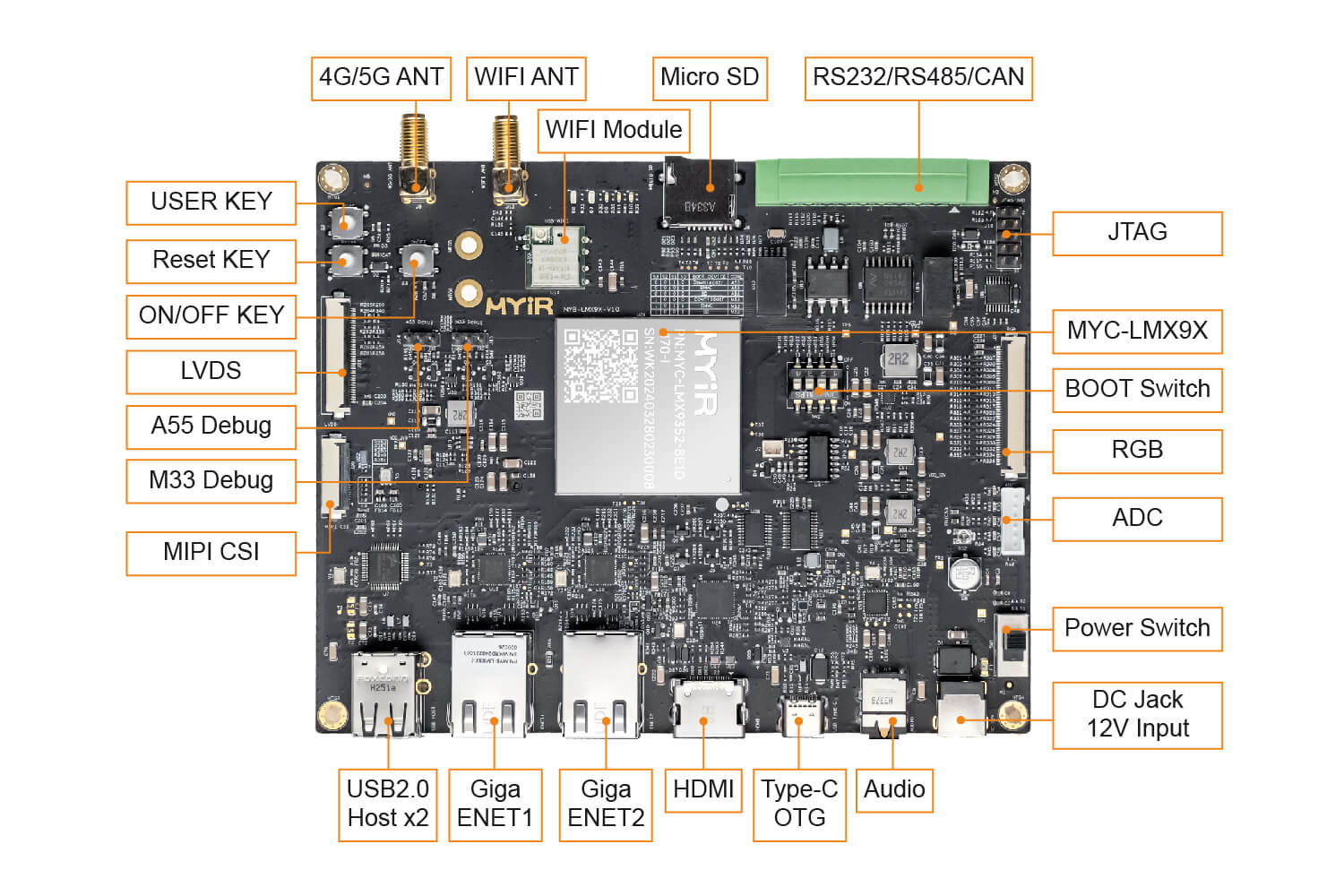
MYIR has released the V2.0.0 software version for its NXP i.MX93 based MYD-LMX9X Development Board. This upgrade prioritizes system security by integrating the EdgeLock® Secure Enclave hardware trust root, delivering a comprehensive three-in-one protection framework encompassing secure boot (AHAB), secure storage, and secure OTA updates. Additionally, the Yocto, UBoot, and Kernel versions have been significantly enhanced, providing a robust foundation for industrial IoT, automotive, and high-security applications.
1. The Compliance Crunch
If you're shipping an industrial gateway or vehicle-mounted controller to Europe or North America, you've seen the same requirement coming up in every RFQ: IEC 62443-4-2 for industrial cybersecurity, ISO 21434 for automotive, or CRA (Cyber Resilience Act) readiness for the EU market.
The checklist typically demands:
Secure boot — verified trust chain from ROM to OS
Encrypted storage — data at rest protected against physical removal
Signed firmware updates — with hardware-backed rollback protection
SBOM — software bill of materials for customs and procurement
Most teams stitch this together with hand-patched U-Boot, custom OP-TEE key derivation, and SWUpdate scripts — six to eight weeks of integration, assuming nothing breaks.
Starting with V2.0.0, the MYD-LMX9X platform ships all of this pre-integrated and build-system-ready.
2. What's in V2.0.0
The update is a full-stack version leap, with security as the organizing principle:
| Component | V1.1.0 | V2.0.0 |
|---|---|---|
| Yocto | 4.2 (Mickledore) | 5.2 (Walnascar) |
| U-Boot | 2023.04 | 2025.04 |
| Linux Kernel | 6.1.55 | 6.12.49 |
Beyond the version numbers, V2.0.0 surfaces the i.MX 93's EdgeLock Secure Enclave through three production-ready subsystems:
Secure Boot (AHAB) — immutable trust chain with containerized image signing
Secure Storage — REE-FS + dm-crypt, keyed from hardware unique key (HUK)
Secure OTA — A/B partitioning + signed SWUpdate with automatic rollback
3. Architecture: The EdgeLock Trust Chain
The i.MX 93's EdgeLock Enclave is a physically isolated security subsystem with its own ROM, firmware, and crypto accelerators. It runs independently of the Cortex-A55 application cores.
The trust chain (AHAB — Advanced High Assurance Boot):
ELE ROM (immutable) → ELE Firmware (signed) → SPL → U-Boot → ATF → Kernel
      ↑                       ↑
   SRK Hash in              Image containers signed
   OTP fuses                with CST (Code Signing Tool)
| Property | Mechanism |
|---|---|
| Immutable root of trust | ELE ROM fixed in silicon — cannot be modified post-manufacturing |
| Containerized signing | Each firmware stage lives in a signed container. One invalid signature stops the boot. |
| OEM Closed mode | After burning SRK Hash into OTP fuses, the chip permanently rejects any unsigned image |
| Rollback protection | Hardware version counters prevent downgrade attacks |
Once you sign the production images and lock the OTP, no third-party code will execute on the device — period.
4. Kernel Boot: Under One Second
Security usually adds boot latency. MYIR's team optimized V2.0.0 to the point where the numbers speak for themselves:
| Mode | Kernel Boot Time |
|---|---|
| Standard (with display) | ≤ 1 second |
| Headless (compute-only, no display drivers) | 0.6 milliseconds |
| Full system (power-on → Linux console) | ≈ 10 seconds |
The 0.6 ms headless figure is achieved by deferring non-critical driver init and using a minimal initramfs that hands off directly to the application — practical for real-time controllers that must be operational within one control cycle.
Secure Storage — Two Layers, Hardware-Keyed
Both storage encryption layers derive from the i.MX 93's Hardware Unique Key (HUK), which never leaves the EdgeLock Enclave.
Layer 1: REE-FS (OP-TEE File Encryption)
Applications call the GlobalPlatform TEE Internal Core API to store persistent objects
Data is encrypted by the TEE before it lands on the Linux filesystem
Encryption key = HUK + TA UUID — each trusted application gets isolation
Raw plaintext never touches the non-secure world
Layer 2: dm-crypt Full-Disk Encryption
dm-crypt+trusted keyring, key sealed by OP-TEEAES-CBC with hardware acceleration via i.MX 93 CAAM engine
Works on eMMC, SD card, or loopback devices
Resists physical flash removal — the key is derived from HUK, not stored on disk
Key Hierarchy (GlobalPlatform model)
HUK (hardware, non-extractable)
    ↓
SSK (Secure Storage Key)
    ↓
TSK (Trusted Storage Key)
    ↓
FEK (File Encryption Key) — unique per file object
An encrypted filesystem from device A cannot be mounted on device B, even if both run identical software.
Bonus: RPMB Anti-Replay
The eMMC RPMB partition stores monotonic write counters and certificates. Combined with the A/B OTA mechanism, it prevents attackers from reinstalling a valid-but-old firmware version as a downgrade attack.
Secure OTA — A/B Partitioning + SWUpdate
V2.0.0 assumes updates happen in the field, unattended, with no physical access:
A signed
.swupackage (RSA signature) is fetched from the update serverSWUpdate verifies the signature against the device's embedded public key
The update writes to the standby partition — the running partition is untouched
On success, U-Boot flips the
bootslotvariableIf boot fails 3 times (
bootcount > bootlimit),altbootcmdautomatically rolls back to the known-good partition
A utility script, swu_update_image_build.sh, generates the signed update package. On the server side, a basic HTTP server is all that's needed — the device polls for updates, verifies the signature, and applies the new slot.
5. One-Click Secure Build
In V2.0.0, enabling the full security stack is a build configuration change:
# In machine configuration, add:
DISTRO_FEATURES:append = " secure-boot"

# Build:
bitbake myir-image-emmc
This single command generates:
AHAB-signed flash images (
flash.bin,os_cntr_signed.bin)SRK Table and SRK Hash — ready for OTP efuse burning
CST (Code Signing Tool) scripts and a pre-configured PKI tree
For A/B dual-partition builds, add DUAL_ROOTFS = "_dual" — two complete root filesystem images are produced with integrated SWUpdate logic.
SPDX SBOM
Every build emits an SPDX 3.0 Software Bill of Materials, listing every package version, license, and dependency. This satisfies:
IEC 62443-4-1 SD-4 (software supply chain security)
ISO 21434 Clause 15 (supply chain cybersecurity)
EU Cyber Resilience Act (software transparency requirements)
6. Who This Is For
| Use Case | Why V2.0.0 Fits |
|---|---|
| EV charging stations | OCPP + ISO 15118 require TLS and firmware integrity. A/B OTA handles field updates without truck rolls. dm-crypt protects billing data at rest. |
| Industrial gateways / RTUs | IEC 62443-4-2 SL2 compliance ready: AHAB secure boot, encrypted storage, signed firmware, SBOM audit trail. |
| Automotive telematics / V2X | ISO 21434 aligned. 0.6 ms kernel fast-wake meets CAN-bus wake-up timing requirements. |
| Medical & building automation | REE-FS stores per-device configuration data with per-TA isolation. dm-crypt protects patient and building data. |
| OEMs shipping to the EU | SBOM + signed updates streamline CE marking and CRA compliance documentation. |
Resources
SDK & documentation: developer.myir.cn
Product page: MYD-LMX9X Development Board
Technical support: support@myir.cn
Full-stack Upgrade – Yocto 5.2 / U‑Boot 2025.04 / Kernel 6.12.49
Secure Boot – AHAB + ELE secure boot
Secure Storage – REE-FS / dm-crypt storage
Industrial OTA – A/B OTA + SWUpdate
Compliance – One-click SBOM
Boot Speed – Boot ~10s.